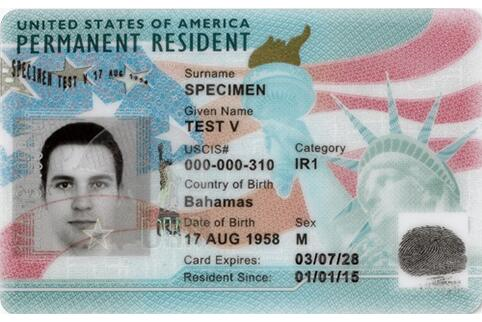
"Green card" is the slang term for the wallet-sized identity card showing that a person has lawful permanent residence in the United States.
"Green card" is the slang term for the wallet-sized photo identity card showing that a foreign national has lawful permanent residence (LPR status) in the United States. It is, in fact, green, though it has gone through various color changes over the years. The official term used for the green card by U.S. Citizenship and Immigration Services (USCIS) is an I-551 or Permanent Resident Card (PRC).
Every year, the United States government grants green cards to thousands of immigrants who meet certain strict characteristics. For example, many people obtain green cards based on:
- a family relationship to a U.S. citizen or permanent resident
- a job offer from a U.S. employer
- making a large investment in a U.S. business, thus helping to create jobs
- winning a slot in the annual diversity visa lottery
- having spent a year or more in the U.S. as a refugee or asylee, or
- fitting into one of several categories of so-called special immigrants.
Below, we discuss some key facts and features of the U.S. green card.
Rights That Come With a U.S. Green Card
Green cards come with the following rights and benefits for their LPR holders:
- Potentially lifetime U.S. residence. The LPR has the legal right to live in the United States on a permanent basis (as long as they abide by certain terms, discussed below). They can live in any U.S. state or territory (such as Puerto Rico or Guam).
- U.S. work opportunities. The LPR can work for U.S. employers without getting any special permission. Even if a U.S. employer sponsored them for the green card, they can switch to a new job (though doing so within a short time of LPR approval might raise questions as to whether they obtained the green card with fraudulent intentions). They can also seek out various federal and state government jobs, including some that require security clearances, although a few positions are reserved for U.S. citizens only.
- Travel rights. The LPR can freely travel not only within the United States, but in and out of the country (subject to the limits on relocating to another country, described below). They will face shorter lines upon return to the U.S. than they might have in the past, when they came as tourists or nonimmigrant visa holders.
- Eventual possibility for dual citizenship. The LPR can (and for now, should) keep the citizenship of their home country. They may apply for U.S. citizenship at a later time. That time period is five years for most green card holders, but three years for people who were married to and living with a U.S. citizen the entire time, up to their swearing-in ceremony. The LPR might also be able to keep their home country's citizenship after becoming a naturalized U.S. citizen, if the home country allows dual or multiple citizenship(s).
- Family sponsorship possibilities. An LPR can sponsor a foreign-born spouse and unmarried children for green cards. They will, however, be classified as "preference relatives," meaning that due to annual limits on allotting such visas, they might have to wait in line, probably for a few years, until their "priority date" is current and a visa number has become available. Only then will they be able to proceed with an application for U.S. residence.
- Health insurance. An LPR is eligible to receive health benefits through the ACA/Obamacare Marketplace, including regular medical coverage and, after a five-year waiting period, coverage under Medicaid and the Children’s Health Insurance Program (CHIP), upon meeting applicable state income and residency rules.
- Student loan financing. The LPR can apply for apply for U.S. government-funded financial aid for education. Some colleges and universities will permit LPRs to take advantage of discounted in-state or resident tuition rates.
- Social Security and benefits. The LPR can obtain a U.S. Social Security number (if they don't have one already), pay into the Social Security system, and if they work for long enough (approximately 10 years), draw on retirement, disability, Medicare (at age 65) and other financial benefits.
- Other state or federal government benefits. Depending on the existence of state and local programs, the LPR's income level, and more, additional public benefits might be available. There is some risk associated with accepting need-based public assistance within the first five years of entry to the United States, however. See the discussion of "public charge" in Legal Reasons a U.S. Immigrant May Be Deported.
Limitations Green Card Holders Must Be Aware Of
Having a green card is not an entirely secure status, and does not come with all the rights and privileges that U.S. citizens have. For example:
- No voting rights. Green card holders cannot vote in federal, state, or local elections, although contributing to or volunteering on behalf of campaigns, candidate, or causes is not a problem.
- Possible deportation for crime. A lawful permanent resident can lose status by committing a crime, violating a law, or doing something else that matches one of the ground of deportability found in Section 237 of the Immigration and Nationality Act (I.N.A.). The crime does not need to be an especially serious or violent one. For example, a DUI could be grounds for deportation if aggravating factors are present, such as a minor riding in the same vehicle. So could falsely claiming U.S. citizenship, or assisting another foreign national to enter the United States unlawfully.
- Possible deportation for immigration violations. For example, an LPR can be deported for willfully failing to advise USCIS of a change of address within 10 days of moving.
- Possible bar to return after foreign travel if LPR becomes inadmissible. A green card holder who leaves the United States and tries to return can, in some cases, become subject to the even broader grounds of inadmissibility found in Section 212 of the I.N.A. This is especially a problem if the LPR spends six months or more outside the United States. It is also a concern for someone who commits a crime while overseas. It's as if such LPRs are asking to enter the United States for the first time, facing higher barriers to entry than existing residents do. What's more, even if the LPR was out of the United States for a short time, if evidence shows that their true residence is in another country, then they can be considered to have "abandoned" their U.S. residence and denied reentry.
- Obligation to pay taxes in the United States. Like any U.S. resident, LPR must pay federal and state taxes (or at least file tax returns). For more information, see Must Green Card Holders Pay U.S. Taxes on Foreign Income?.
Why the U.S. Green Card Expires Every 10 Years
At one time, green cards were issued with no expiration date. Now, however, USCIS wants people to apply for a new card every 10 years. Don't worry, this doesn't mean that your permanent residence itself expires, just the card that proves it. The renewal application is fairly short and simple. USCIS can, however, call you in for an interview or to provide biometrics (fingerprints, photograph, and/or signature) in order to conduct security checks and possibly uncover grounds of deportability. (Also see What Happens at the USCIS Biometrics Appointment?.)
Then again, if you fail to renew the green card, you risk running into trouble with USCIS if it discovers that you have violated the law requiring you to carry an unexpired green card with you at all times.
Don't confuse the 10-year green card expiration date with the 2-year expiration date put on green cards held by conditional residents (people who got their status due to investment or a recent marriage to a U.S. citizen). The expiration of that card truly can mean the expiration of legal status in the United States. Conditional residents must, within 90 days before the expiration date, file Form I-751 (marriage-based cases) or I-829 (investment-based cases) in order to convert to permanent resident status. In other ways, however, conditional residents are treated much like permanent residents (and their time as conditional residents ultimately counts toward eligibility for naturalized U.S. citizenship).
Who Shouldn't Apply for a U.S. Green Card
If you are in the United States unlawfully, realize that applying for a green card will bring you to the attention of U.S. immigration authorities and, if your application fails, lead to your deportation.
On the other side of the coin, if you have a strong case for a green card but don't really want to live in the United States at the moment, there's little point in applying for it now. A green card is not a travel document. It is intended for immigrants who truly intend to live in the United States. If you appear to be coming and going so frequently that it becomes clear that the United States is not your true home, you could lose your right to a green card and LPR status.
When Do New Immigrants Receive the Actual Card?
You will not be handed a green card the minute you are approved for U.S. permanent residence. Immigrants who come from overseas enter the United States with an immigrant visa, and are then given a temporary stamp in their passport called an "I-551," which indicates that they are lawful U.S. residents.
Immigrants who adjust status in the United States (in other words, who get approved for U.S. residence by interacting solely with USCIS, without visiting a U.S. consulate) will be given a letter of approval at or after their interview.
In both cases, the actual green card will be sent by mail, and typically arrive some weeks later. You need to pay the USCIS Immigrant Fee in order for it to be processed.
For More Information
Information about your rights and benefits as a current or aspiring lawful permanent resident can be obtained from the USCIS website (in particular check out the Welcome to the United States: A Guide for New Immigrants pamphlet and from the relevant federal or local agencies. We recommend consulting an attorney if you would like more personalized advice or assistance in analyzing your possible eligibility, filling out the relevant forms, and dealing with the U.S. immigration bureaucracy in assisting you to obtain a green card.
