A summary of the main advantages and disadvantages of forming a limited liability company (LLC)
Protect Your Business
Create your LLC with Nolo
A limited liability company (LLC) is a popular entity choice for many business owners. You can form an LLC by yourself or with other owners. Let's look at a quick summary of the pros and cons of forming an LLC.
What Is an LLC?
An "LLC" is a legal business entity recognized by all states. Anyone can practically form an LLC. Its flexibility makes an LLC an attractive business structure for business owners, big and small. An LLC combines the limited liability of a corporation with the simplicity and lack of formalities of a sole proprietorship or general partnership.
An LLC, like a corporation or limited partnership, is a registered business entity. To form an LLC, you'll need to file formation paperwork with your state. But it's important to note that an LLC isn't a tax entity. Instead, your LLC can be taxed as a partnership, corporation, or other tax structure. The availability of tax options is one of an LLC's many advantages.
You'll find many advantages to forming an LLC from its tax benefits to its flexible management structure. But you should also be aware of its few disadvantages.
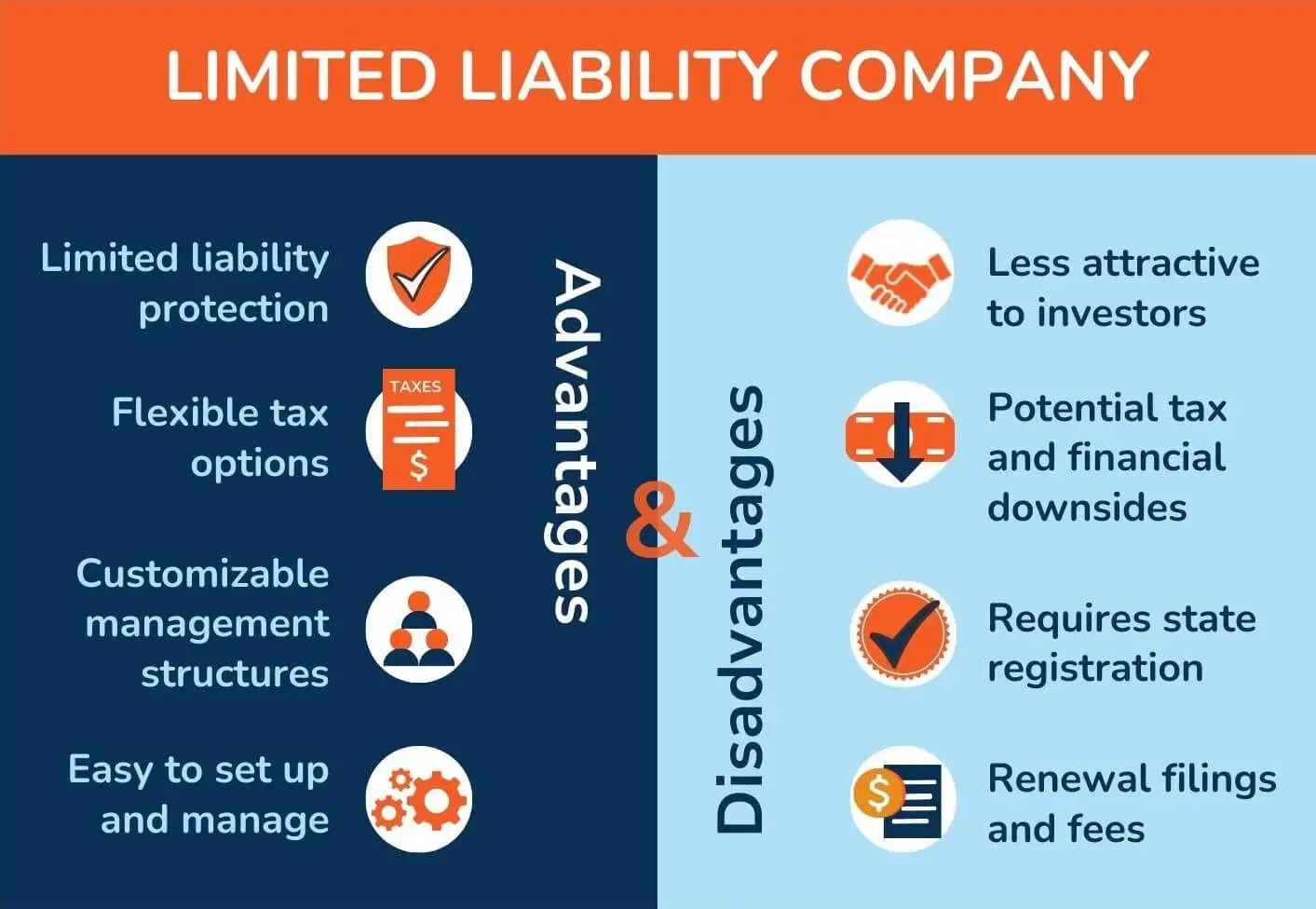
Advantages of Forming an LLC
An LLC has a range of benefits, from its management structure to its liability protections. Let's look at the common pros of this popular business structure.
Limited Liability Protection for LLC Owners
Perhaps the biggest benefit of forming an LLC is limited liability protection. LLCs are considered separate entities from their owners. As a result, owners of an LLC are personally protected from the debts, liabilities, and obligations of the LLC. In other words, creditors can't go after LLC owners personally to cover unpaid business debts.
For example, suppose an LLC defaults on a $10,000 business loan and the creditor files a claim against the LLC. The creditor couldn't force the LLC owners to take money from their personal accounts or sell their personal assets, like their car, to cover the debt. The creditor would have to pursue the LLC itself to recover the debt.
Likewise, LLC owners aren't liable for the wrongdoings of other LLC members. For instance, if one LLC member acts in bad faith and causes harm to a client, the other LLC members aren't on the hook for their fellow member's bad acts.
Flexible Tax Options
As mentioned earlier, LLCs aren't tax entities. Instead, LLCs are business entities that can be taxed in various ways. Depending on a few factors, LLCs can be taxed as either:
- disregarded entities
- partnerships
- corporations, or
- S corporations.
You can read extensively about the different taxing options in our article on how an LLC and its members are taxed.
Default Pass-Through Tax Status
By default, LLCs are treated as "pass-through" entities for tax purposes, much like a sole proprietorship or partnership. The default tax classification status depends on the number of LLC owners.
Single-member LLCs are taxed as disregarded entities. A single-member LLC and its owner are seen as one inseparable entity for tax purposes. A sole LLC owner will report gains and losses from their LLC on their personal tax return.
Multi-member LLCs are taxed as partnerships. The LLC files a partnership return, a type of informational return. The LLC itself doesn't pay taxes. The LLC then provides K-1s to its members. LLC members then report and pay taxes on their personal returns.
Available Tax Elections
While your LLC is taxed as a disregarded entity or partnership by default, you can elect a different tax classification. Specifically, you can elect to have your LLC taxed as a corporation or S corporation. But keep in mind there are restrictions on who can elect to be taxed as S corporations. And you'll want to consider the pros and cons of electing corporate tax status before firing any official paperwork.
Electing corporate tax status. Corporations are subject to double taxation. If you elect to have your LLC taxed as a corporation, then the LLC itself will be taxed and the LLC members (considered "shareholders") will be taxed on any dividends earned. While there are certain corporate tax advantages, you should talk to a business attorney or tax professional to see whether this election is the right fit for your LLC. You can elect to have your LLC taxed as a corporation by filing Form 8832 with the IRS.
Electing S corporation tax status. An S corporation has several unique tax advantages that might be worthwhile to consider. Two of the main draws of an S corporation are it operates a pass-through tax entity and LLC members (S corporation shareholders) can avoid self-employment taxes. But your LLC must qualify to be taxed as an S corporation. Each LLC member must be an individual (or trust or estate) who's a U.S. citizen or resident and you can't have more than 100 members. For more, read about S corporation shareholders and taxes.
Customizable Management Structures
One of the biggest advantages of an LLC relates to how the LLC is run in the day-to-day. An LLC can operate under various management structures and still be considered an LLC. In contrast, a corporation generally must have a board of directors and officers making management decisions. And, a partnership either has only general partners that share in the partnership management or limited and general partners where general partners run the company and limited partners invest money without getting involved in the company management.
Broadly speaking, LLCs have two management structures:
- A member-managed LLC: The LLC is managed by all LLC members. You can divvy up the management duties in your LLC's operating agreement. For instance, you can put one member in charge of finances, one in charge of sales, one in charge of customer relations, and so on.
- A manager-managed LLC: The LLC is managed by one or more managers. Your LLC manager can be a specified member or a nonmember. You can choose to have multiple managers and select a mix of members and nonmembers.
Most LLCs are member-managed. In some states, if you don't specify your management structure, then your LLC is assumed to be member-managed. But if your LLC has a lot of members or some members want to act more as passive investors, choosing a manager-managed LLC option could be the best option.
Make sure you specify your chosen management structure in your operating agreement. How you execute your LLC's management structure is relatively flexible. So it's important to outline how you want your LLC to be run in writing.
Easy to Set Up and Manage
When compared to a corporation, an LLC is fairly easy to create and maintain. While you do have to submit paperwork to the state to form an LLC and usually pay a filing fee, you typically don't have to provide much information upfront about your LLC.
In addition, it's easy to keep your LLC active and in good standing with the state. Most states require LLCs to submit a report every one to two years to keep information about the LLC up to date. These states usually require a relatively inexpensive filing fee.
In most states, you can submit these filings and pay any associated costs online. While every state is different, the process is usually fairly straightforward and quick to complete.
State laws are also usually generous when it comes to compliance requirements. Most states don't even require LLCs to have operating agreements. Moreover, LLCs don't need to hold meetings, keep minute meetings, or keep at corporate records book for inspection.
Disadvantages of Forming an LLC
An LLC has limitations and isn't for everyone. If you're not interested in registering your business with the state or you're looking to maximize your business's investment potential, then another business structure might be a better fit. Let's look at some of the shortcomings of an LLC.
Less Attractive to Investors
Forming a business with limited liability protection can make matters easier when opening a bank account and applying for a business loan. But investors might be looking for a business with more organizational structure and formalities when deciding where to put their money. You'll have more luck raising funds from serious investors if you form a corporation.
In addition, it's much easier—and more attractive to investors—to offer stock in exchange for investment (called "equity investment") instead of an ownership interest in an LLC. When investors gain an ownership interest in an LLC, they become members. As a result, they'll need to follow the rules set out in the LLC's operating agreement. It's common for LLCs to put transfer and ownership restrictions on LLC interests to limit who can become a member and when this ownership can change. These restrictions don't typically exist with stock transfers.
Some Financial Downsides Based on Tax Structure
While the tax options available to an LLC make it a great choice for business owners, each tax structure has its benefits and drawbacks. It follows that when you choose one tax structure over another, you'll gain the benefits of your chosen tax structure but lose the potential advantages of the other tax option. Below are some of the more common tax considerations for LLC owners. But keep in mind, LLCs give you the flexibility to choose which tax benefits to take advantage of. Forming a corporation or partnership will lock you into a certain tax arrangement.
Profits might be subject to Social Security and Medicare taxes. In some circumstances, owners of an LLC might end up paying more taxes than owners of a corporation. Salaries and profits of an LLC are subject to self-employment taxes, consisting of the federal Social Security and Medicare taxes. As of 2025, these taxes are equal to a combined 15.3%. With a corporation, only salaries (and not profits) are subject to such taxes.
Owners must immediately recognize profits. A regular C corporation doesn't have to immediately distribute its profits to its shareholders as a dividend. So, shareholders in a C corporation aren't always taxed on the corporation's profits. Because an LLC isn't subject to double taxation and the income passes through to the owners, the LLC's profits are automatically included in a member's income. It doesn't matter if the LLC actually distributes these profits to the owners. The LLC owner is still taxed on their share of the LLC profits.
Fewer fringe benefits. Employees of an LLC who receive fringe benefits—such as group insurance, medical reimbursement plans, medical insurance, and parking—must treat these benefits as taxable income. The same is true for employees who own more than 2% of an S-corporation. However, employees of a regular C corporation who receive fringe benefits don't have to report these benefits as taxable income.
LLC Requires Registration, Renewals, and Fees
If you want to form an LLC, you must file organizational documents with your state to create it. Your state probably also charges a fee to form your LLC. You don't need to file any paperwork or pay a fee to create a partnership or sole proprietorship.
In addition to your startup fees with the state, most states require LLCs to file renewal documents (called "reports" or "renewals") every one or two years. You'll also probably need to pay a renewal fee. Some states also charge LLCs a franchise tax or fee.
Your total LLC startup and upkeep costs will depend on your state. But be prepared to submit paperwork to both start your LLC and to keep it in good standing as well as pay some filing fees with your secretary of state's office.
LLC FAQ
Now that we've talked about the pros and cons of LLCs, Let's look at some of the frequently asked questions around this business structure.
- Should you form an LLC?
- What's the difference between a corporation and an LLC?
- What's the difference between a partnership and an LLC?
- How do you create an LLC?
Should you form an LLC?
Overall, an LLC is an adaptable business structure with plenty of benefits to consider. It's a popular business structure for a reason. If you're not sure what your business will evolve into, organizing an LLC can give you the flexibility you need to account for changing business needs.
If you're not sure what type of business structure to choose, consult a business attorney. They can help you work through the pros and cons of each type of business to make sure you pick the right one for your business.
What's the difference between a corporation and an LLC?
For both a corporation and LLC, you must file paperwork with your state to legally create these entities. Both of these entity types give their owners limited liability. In other words, both LLC owners and corporate shareholders are personally protected from the business's debts, liabilities, and obligations.
Corporations generally have more formalities than LLCs. Corporations are typically required to hold annual meetings, keep meeting minutes and other corporate records, and follow state reporting requirements.
Moreover, corporations face double taxation while LLCs will be taxed as pass-through tax entities by default. A corporation will automatically be taxed as a corporation unless the corporation elects to be taxed as an S corporation. Alternatively, an LLC is taxed as a partnership (or disregarded entity) by default. An LLC will only be taxed as a corporation or S corporation if it files a form with the IRS to elect these tax statuses.
What's the difference between a partnership and an LLC?
An LLC requires business registration and can be taxed as a partnership or corporation. A partnership, on the other hand, is automatically created when two or more people go into business together. A partnership will be taxed as a partnership.
Both business types can be taxed as pass-through entities. If your LLC is taxed as a partnership, then you'll use the same tax forms and abide by the same deadlines as a partnership.
But regardless of how an LLC is taxed, LLC owners enjoy personal liability protection. In contrast, with a partnership, all partners are personally liable for the business's debts. But partners can limit their liability by forming a limited partnership or limited liability partnership and being classified as limited partners.
Finally, an LLC can consist of only one member. A partnership must have two or more members.
How do you create an LLC?
You legally create an LLC by filing an organizational document with your state. Typically, you'll file this document with your secretary of state's office. The organizational document is usually called "articles of organization," a "certificate of formation," or something similar.
For detailed instructions, see our article on how to start an LLC. You can get step-by-step instructions for your state using our state guide to forming an LLC.