Corporations can be intimidating. Balancing bylaws with shareholders and tax requirements can seem onerous. Follow these steps to clear up the corporation formation process.

When you have an idea that you want to turn into your business, you'll need to take the legal steps necessary to start your venture. Many new business owners decide to form a corporation. A corporation can be an appealing option for companies because it provides limited liability to its owners and rights and privileges to investors.
If you've decided that a corporation is the best fit for your business, follow these steps to start your corporation.
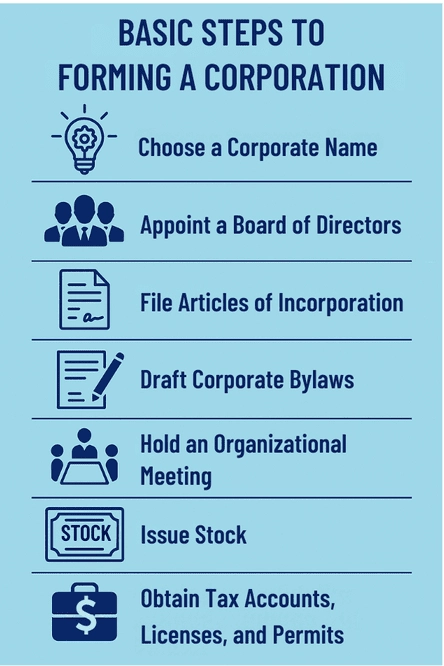
Step 1: Choose a Corporate Name
The first step in creating your corporation is perhaps the most exciting. You'll need to choose a name for your business. Typically, states have laws about what you can and can't name your corporation.
Specifically, most states require that a corporation's name end in a corporate designator such as:
- "corporation"
- "incorporated"
- "company," or
- "limited."
In addition, most states require that your corporate name be distinguishable from other businesses filed with the state. For instance, suppose you want to use the name "Knuckles, Inc." for your corporation. But a limited liability company (LLC) called "Knuckles, LLC" is already registered in your state. In that case, the names are basically identical and you'd probably need to pick another name for your corporation.
States typically have an online business database (commonly found on the secretary of state's website) that you can search through to see whether your proposed business name is available. You should also check your state's laws for specific requirements about naming corporations.
Do You Need a DBA for Your Corporation?
Some companies register under one name but do business under another. When a business doesn't use its legal name out in the real world, it's using a "DBA," short for "doing business as." You'll sometimes find DBAs referred to as:
- "trade names"
- "fictitious names," or
- "assumed names."
For example, suppose you run a farm providing seasonal berry picking and a pumpkin patch. You register your farm as a corporation under the legal name "TDK, Inc." However, your legal name isn't very marketable, so you advertise your farm around town as "Tara Oaks Farm." You'd be using a DBA for your corporation: Tara Oaks Farm.
Not every corporation uses a DBA, but you might find it useful to adopt one. For instance, you might want to register your corporation under a particular name for legal or sentimental reasons, but use another name to do business because it's more searchable or marketable. Alternatively, your corporation could own multiple shops with different names with separate branding.
In most states, if you use a DBA, you'll need to register it with your state or county. However, in other states, registration is optional. To register your DBA, you typically must file a form and pay a small fee. The registration could last a set number of years or until you cancel the registration. Check out your state's DBA laws for more information.
Should You Trademark Your Business Name?
Companies are increasingly investing in intellectual property. Businesses copyright literature, art, and computer code. Innovators patent technological and biological processes. And, enterprises trademark business names, logos, and slogans.
A "trademark" is a word, phrase, symbol, or design (or a combination of these elements) that identifies the source of goods and services. For example, when you see the name "NIKE" or the associated swoosh logo, you know that the shoes, athletic wear, or sports equipment you're buying comes from Nike, Inc. When a company can build goodwill in the marketplace, it's important for that company to be able to communicate to consumers which products or services are theirs. In other words, you'd want to know that you're buying shoes from Nike and not shoes from a brand that you don't know or trust.
Registering your business name as a trademark with the U.S. Patent and Trademark Office (USPTO) protects your brand nationwide. When you have a registered trademark, others can't use the same or a confusingly similar trademark for related goods and services. Specifically, other companies can't profit off the goodwill you've established or erode your relationship with purchasers by selling or providing lower-quality goods or services.
It can be a worthwhile investment to register your business name. But not all names are eligible for registration. Your business name will need to be:
- unique (different from any other trademark out there), and
- distinctive (not generic or descriptive).
If you're interested in trademark protections, talk to an intellectual property attorney early. They can advise you on whether your proposed business name can be trademarked.
Step 2: Appoint a Board of Directors
A corporation is managed by its board of directors, which must approve major business decisions. These major decisions can include:
- declaring a dividend
- electing officers and setting the terms of their employment
- amending bylaws or the articles of incorporation, and
- approving any corporate merger, reorganization, or other significant corporate transaction.
Some states require corporations to have initial directors at the time of formation. Other states don't require your corporation to have directors, but they'll ask you to name directors, if you have any, in your formation paperwork.
Oftentimes, the incorporators (the ones that form the corporation) appoint the initial directors. Shareholders will then elect the subsequent directors at annual shareholders' meetings. States generally require corporations to have at least one director.
Directors of a corporation owe fiduciary duties to the corporation, meaning that the directors must act:
- in good faith (duty of good faith)
- with reasonable care (duty of care), and
- in the best interest of the corporation (duty of loyalty).
If a director stands to personally gain from a transaction with the corporation, they must disclose this fact and refrain from voting on the matter, if possible.
A director can be, but isn't required to be, either a shareholder or an officer. Directors typically serve for a limited term, for example, one or two years.
Step 3: File Articles of Incorporation
After you've chosen a name for your corporation and appointed the initial directors, you're ready to file your paperwork with the state to legally create your corporation. To form a corporation, you'll file articles of incorporation (sometimes called a "certificate of incorporation").
While every state has its own requirements, you'll generally need to provide basic information about your corporation in your articles, including:
- your corporation's name
- the name and address of your corporation's registered agent
- your corporation's principal office and mailing addresses
- the name and address of each incorporator
- the number of shares your corporation is authorized to issue, and
- whether your incorporation will have more than one class of stock.
Most states allow you to file your articles of incorporation online. You can also usually mail your articles to your secretary of state's office. Be prepared to pay a filing fee. Oftentimes, the fee depends on the number of shares your corporation is authorized to issue.
What Is a Registered Agent?
A "registered agent" is a person or business that you designate to receive official papers on your corporation's behalf. A registered agent can sometimes be called a "resident agent" or "agent for service of process."
Your agent will be in charge of receiving any court documents, renewal or tax notices, and other legal documents during normal business hours. They must then forward these papers to your corporation.
Typically, a corporation will appoint one of the following as its registered agent:
- an officer
- an employee
- a director
- a lawyer, or
- a registered agent service.
If you have a small corporation, you might serve as your company's director, executive officer, and registered agent.
What State Should You Form Your Corporation?
Before you file your paperwork, make sure you know which state you want to incorporate your business in. The easiest choice is the state where your business is located (or where you live). For instance, if you plan to open a dry cleaning shop in San Diego, then it might make the most sense to form your corporation in California.
But starting a corporation in other states has its advantages. For example, you might've heard of many large companies incorporating in Delaware. This state is an attractive option for businesses because it offers corporations:
- well-developed corporate law
- friendly regulations
- privacy, and
- a dedicated business court.
Other companies consider incorporating in Nevada or Wyoming because these states provide owners with more privacy and liability protections.
If you operate your business in one state but incorporate in another, you won't find any tax savings. While some states have no corporate income or sales tax, you'll only benefit from these tax-friendly structures if you do business in those states. You'll be responsible for filing and paying taxes where your corporation does business. In addition, you'll need to register as a foreign corporation in every state where you'll do business, other than in your state of incorporation. So if you incorporate outside of your state, you'll likely end up paying more in the end.
Step 4: Draft Corporate Bylaws
Your corporation's bylaws are perhaps your company's most important foundational document. Corporate bylaws provide a blueprint for how a corporation will be run and include rules and procedures for:
- the appointment, election, and duties of directors and officers
- shareholder meetings
- board of directors meetings
- corporate records and reports
- corporate shares, and
- other topics like insurance, indemnification, and bylaw amendments.
Depending on the size and operations of your corporation, it might make sense to address other subjects. You should consider working with a business attorney to help you draft or review your corporation's bylaws.
Step 5: Hold An Organizational Meeting
Now that you've created your corporation and have drafted bylaws, it's time to hold your corporation's first meeting. This meeting is called an "organizational meeting" because its purpose is to finish organizing the corporation. The corporation's incorporators or initial board of directors generally hold this meeting.
At this meeting, the directors should
- appoint corporate officers (for example, a president, secretary, and treasurer)
- adopt the corporate bylaws
- authorize the issuance of shares of stock
- adopt an official stock certificate form and corporate seal, and
- set the corporation's fiscal or accounting year.
If your corporation is interested in being taxed as an S corporation, you should also finalize this decision at the first meeting. You should take meeting minutes to keep with your corporate records.
Step 6: Issue Stock
Once the board of directors has authorized the issuance of the corporation's stock, you can now formally issue shares. Owners of a corporation's shares are owners of the corporation. A corporation typically issues shares to people (and businesses) in exchange for capital contributions to the corporation, such as money or services.
When you issue stock, it's important to keep a record of:
- who was issued the stock
- how many shares was that person (or business) was issued
- what kind of stock was issued, and
- what the shareholder gave the corporation for the stock.
You'll need to prepare a stock certificate for the transaction.
Draft a Shareholders' Agreement
When you issue stock, you should have the shareholder sign a shareholders' agreement. A "shareholders' agreement" is a contract among the shareholders about how the corporation will be run and the rights and responsibilities of each shareholder.
These agreements typically outline:
- the shareholders' voting rights
- how the corporation will be managed and operated by the board of directors
- how shares can be transferred, including restrictions and other policies (some corporations use a separate agreement called a "buyout agreement" to cover these terms)
- how shares are valued and priced
- share dividends (distributions)
- dissolution procedures
- information rights, and
- other general provisions.
Comply With Securities Laws
Generally, when corporations issue stock, they must register the sale of their shares with the Securities and Exchange Commission (SEC) and their state securities agency. However, many smaller corporations qualify for an important registration exemption.
The SEC doesn't require corporations to register a private offering of their stock. A "private offering" is a non-advertised sale of stock to either:
- a limited number of people (generally 35 or fewer), or
- those who, because of their net worth or income-earning capacity, can reasonably be expected to take care of themselves in the investment process.
Most states have followed suit and provide their own version of this exemption. So if you have a smaller corporation with limited investors and owners, you probably won't need to register the sale of your corporation's stock.
While your corporation will likely qualify for this registration exemption, you should still familiarize yourself with federal and state securities laws.
Step 7: Obtain Appropriate Tax Accounts, Licenses, and Permits
You've legally formed your corporation and prepared all of your governing documents. But you're not done quite yet. You still have a few more legal requirements to satisfy before you can open for business.
Register for Corporate Taxes
Because you created a corporation, your business will be subject to federal and state corporate income tax by default. Corporations have double taxation, meaning corporations are essentially taxed twice. The corporation is taxed on its profits, and the shareholders are taxed on the dividends they receive from the corporation.
Federal corporate income tax. Corporations must file IRS Form 1120, U.S. Corporate Income Tax Return, with the IRS. Corporations generally must make quarterly income tax payments to the IRS.
State corporate income tax. You'll need to register your corporation with your state tax agency. Most states allow businesses to register for a tax account online. After registering your corporation, you must file the applicable income tax form and pay any due taxes to your state. Some states don't have a corporate income tax or levy a similar tax (like a franchise tax) on corporations.
Taxes for employees. If your corporation has employees (including shareholders who are employees), then the corporation and shareholders are responsible for payroll taxes. The corporation must pay half of the employee's share of Social Security and Medicare taxes (known as "FICA taxes") and unemployment taxes. The employee must pay the other half of the FICA taxes as well as income tax on their salary. These taxes are withheld from the employee's paycheck.
Your corporation must register with the state to pay employment taxes. Typically, businesses register with one state agency as an employer to withhold employee wages and another state agency to pay unemployment insurance tax.
Other taxes. Your corporation might be responsible for other taxes, such as sales and use tax. You'll likely need to register for other tax accounts to pay all applicable taxes owed. Check with your state and local governments for filing responsibilities.
Electing S Corporation Tax Status
While your corporation will be taxed as a C corporation by default, you can elect to have your company taxed as an S corporation. An "S corporation" is a pass-through tax entity, meaning that the income passes through the corporation to the shareholders, who are then taxed on their share of the corporation's distributions. As an S corporation, the company itself isn't taxed on its profits.
If you're considering S corporation tax status, you should consult with a business or tax attorney about the advantages and disadvantages of this election.
Apply for Licenses and Permits
Depending on your location and business activities, your corporation might need to apply for business licenses and permits with the federal, state, or local governments. Common licenses and permits include:
- professional licenses
- licenses specific to your business activities or industry
- seller's permit
- zoning permits
- building permits, and
- environmental permits.
Check with your state for licensing requirements.
Ongoing Legal Requirements for Corporations
After you form your corporation, you'll still be responsible for keeping up with ongoing legal and tax requirements. For example, many states require corporations to file periodic reports with the secretary of state's office either every year or every other year. You'll usually need to pay a fee along with the report.
In addition to annual or biennial reports, your corporation will be responsible for filing and paying taxes. If you applied for any licenses or permits, you might also need to renew these as well and pay a renewal fee.
Ready to start your corporation?
In This Article
- Step 1: Choose a Corporate Name
- Step 2: Appoint a Board of Directors
- Step 3: File Articles of Incorporation
- Step 4: Draft Corporate Bylaws
- Step 5: Hold An Organizational Meeting
- Step 6: Issue Stock
- Step 7: Obtain Appropriate Tax Accounts, Licenses, and Permits
- Ongoing Legal Requirements for Corporations