If you’ve been hurt in a car crash or other accident and don’t have insurance, you still have options for covering your medical bills.
Sometimes, due to life events or financial circumstances, people find themselves without health insurance. This raises the question: if you get hurt in an accident while uninsured, how will you be able to afford medical treatment? In this article we’ll discuss when you might be able to:
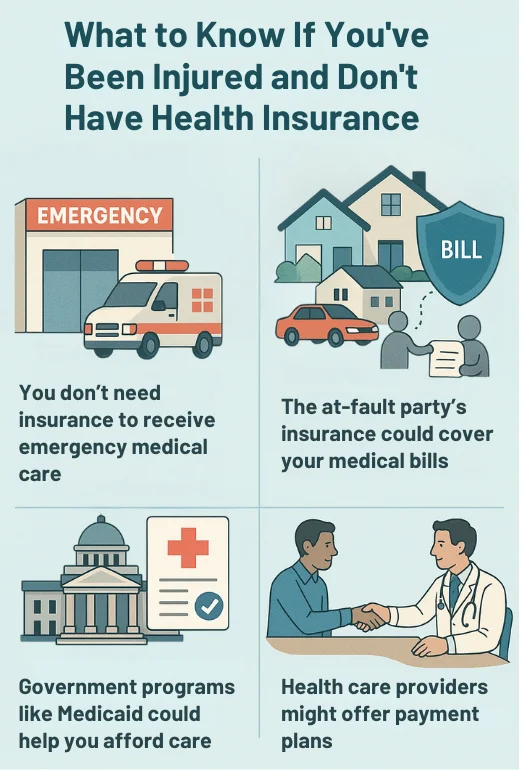
- pursue compensation through other insurance options (for example, an at-fault party’s auto or property coverage)
- receive treatment for your injuries through the federal Medicaid program
- qualify for programs that offer free or reduced-cost care, or
- work out payment plans that make the cost of treatment manageable.
We’ll also explain why a lawsuit is probably not your best option, and why you shouldn’t let concerns about your insurance coverage keep you from seeking emergency medical treatment.
In This Article
- Can You Sue to Cover Your Medical Bills?
- Getting Emergency Medical Treatment Without Health Insurance: What EMTALA Covers
- Filing a Claim Against an At-Fault Party for Medical Expenses
- Using No-Fault Insurance and PIP Claims to Cover Your Medical Bills
- Qualifying for Medicaid or Other Programs After an Accident
- Medical Bill Payment Plans and Provider Liens
- Learn More About Personal Injury Compensation
Can You Sue to Cover Your Medical Bills?
You may receive compensation for your medical bills and other damages once you settle a personal injury claim or win a lawsuit. But that may take months or even years—and you need to pay your medical bills now.
It might seem unfair that you’re on the hook for your own medical costs even if someone else is clearly at fault for your injuries. But the law doesn't require an at-fault party (or their insurance company) to pay a victim’s medical bills as they’re accrued. The only thing the law requires is that, if the other person is found legally responsible for the accident, they must pay you damages to resolve your lawsuit.
Meanwhile, though, you are responsible for the payment of your medical bills as you incur them. In the sections below, we'll take a closer look at your options for getting at least some of these costs covered.
Getting Emergency Medical Treatment Without Health Insurance: What EMTALA Covers
If you’ve been injured in a car crash or other accident, you should seek emergency care. This is true even if you have no health or auto insurance, or are afraid your insurance is inadequate. Under a federal law called the Emergency Medical Treatment and Active Labor Act (EMTALA), emergency rooms in the United States are not allowed to turn patients away based on their insurance coverage or ability to pay.
Keep in mind that EMTALA does not entitle an injured person to free or open-ended medical care. For example, EMTALA only covers “emergency medical conditions.” An emergency medical condition is one that, absent immediate medical attention, will likely:
- jeopardize a patient’s health
- seriously impair a patient’s bodily functions, or
- lead to serious dysfunction of a patient’s organs.
So, EMTALA would not cover:
- treatment for injuries (even significant ones) that do not qualify as “emergency medical conditions,” or
- ongoing care after a patient's condition is stable.
It’s also crucial to remember that EMTALA does not remove a person’s responsibility for the costs of their medical care. The law just prevents healthcare providers from refusing to treat people who cannot pay for their treatment. You are still legally responsible for your medical bills and any medical debt. (We'll talk more below about options for receiving necessary care at a manageable cost.)
Filing a Claim Against an At-Fault Party for Medical Expenses
If someone else is responsible for your injuries, you should find out if that person has insurance. If they do, then you can file a claim seeking compensation for your medical costs. Depending on how the accident happened, and the severity of your injuries, the claims process could take a while. But it will generally be quicker than a lawsuit, and as a rule you must complete the claims process before you’re allowed to go to court.
Using Someone Else's Med Pay Coverage for Your Accident Injuries
Some automobile and property insurance policies have what is called medical payment insurance coverage (known as “med pay” coverage). Med pay coverage can help pay the medical bills of:
- someone injured on property owned or rented by the insured (regardless of who is at fault for the accident), or
- certain people injured by an insured person’s bad driving.
There are two important limits on med pay coverage that you should keep in mind:
- Med pay might not fully cover your medical costs, since the policy limits are generally less than $10,000. After your bills exceed the med pay policy limits, you will be responsible for paying them.
- In a car accident, med pay only covers the at-fault driver and that driver’s passengers.
Claiming Medical Costs Through an At-Fault Driver's Bodily Injury Liability Insurance
Med pay only covers the insured driver and their passengers. But, if the driver of another car caused your injuries, you may be able to recover compensation through that person’s bodily injury liability coverage. Nearly every state requires drivers to carry this type of coverage (as of 2025 Florida is the only exception).
Every driver is legally required to carry at least some auto insurance. This increases the likelihood that an at-fault driver will have insurance. But, in some states, it also creates a penalty for people who drive without coverage.
These states have so-called “no play, no pay” laws. Under these laws, a driver with no auto insurance cannot fully recover their damages from another driver—even if the other driver caused the accident. This prevents drivers from free-loading—if someone isn’t willing to pay for a policy that protects other people from their bad driving, they cannot fully benefit from other drivers’ insurance coverage.
Using No-Fault Insurance and PIP Claims to Cover Your Medical Bills
No-fault car insurance exists in about a dozen states. Under this system, your own automobile insurer will pay some or all of your medical bills and lost earnings if you get into a car accident, regardless of who was at fault. So, this can be an option if you have auto insurance in a no-fault state, but do not have health insurance.
A claim under no-fault insurance is often called a Personal Injury Protection (PIP) claim. But every state’s law is different. In some “no-fault” states, there is a limit as to the amount of medical bills that your insurer will pay; in others, there is no limit. So, if you get into a car accident in a no-fault state, you may want to contact a car accident lawyer to find out what your rights are under your state’s no-fault laws. See our state laws page to learn more about the rules where you live.
Qualifying for Medicaid or Other Programs After an Accident
Medicaid is a federal program that provides health insurance to low-income people through state agencies. The federal government does not provide insurance directly to citizens. Instead, it sends the funds to the states, and the states run the health insurance programs.
If you lose your health insurance (or your job) as a result of an accident, you may qualify for Medicaid. Medicaid is not charity; it is a health insurance program that the government designed for low-income people.
If you get into an accident and have no health insurance, you should go to your state’s Medicaid office and find out if you qualify for the program. If you do qualify, then Medicaid will pay your medical bills going forward. It may even pay some of your past bills, depending on your state’s Medicaid laws and regulations.
In addition to Medicaid, you may be able to get help from other programs that assist low-income, uninsured, and underinsured individuals. For example:
- You may be able to get treatment from a local community health center.
- Non-profit hospitals are required by law to provide financial assistance to eligible patients.
- In some states, so-called "charity care" laws entitle eligible patients to free or discounted care, or to government financial assistance.
Medical Bill Payment Plans and Provider Liens
If you're uninsured and unable to afford necessary medical care, you may be able to negotiate with your provider to either reduce what you owe, or set up a payment plan that you can afford. It can be intimidating to negotiate with health care providers (especially large companies). So, you might benefit from consulting with an attorney or medical billing advocate who can represent your interests.
In addition, some providers will agree to treat the patient in return for the patient’s promise to pay the bills from the proceeds of a settlement or verdict. For example, physicians and chiropractors who specialize in treating accident victims know that many of their patients have no health insurance, and are willing to work with them on payment.
In this situation, the provider will have the patient sign a personal injury lien, which will be sent to the patient’s lawyer. This lien is a binding contract between the patient and the provider. It requires the lawyer to pay the provider from the settlement or verdict proceeds before the patient/client gets any money from the case.
Learn More About Personal Injury Compensation
If you’ve been in an accident and are having trouble arranging medical treatment due to lack of insurance, you might benefit from speaking with an accident lawyer. Even if you don’t plan on suing anyone, an attorney experienced with these kinds of cases should be able to explain your options and help you get the best treatment available under your state’s laws.

In This Article
- Can You Sue to Cover Your Medical Bills?
- Getting Emergency Medical Treatment Without Health Insurance: What EMTALA Covers
- Filing a Claim Against an At-Fault Party for Medical Expenses
- Using No-Fault Insurance and PIP Claims to Cover Your Medical Bills
- Qualifying for Medicaid or Other Programs After an Accident
- Medical Bill Payment Plans and Provider Liens
- Learn More About Personal Injury Compensation