Learn what elements of a business can and should be protected through U.S. copyright law.
Protect Your Business
Create your LLC with Nolo
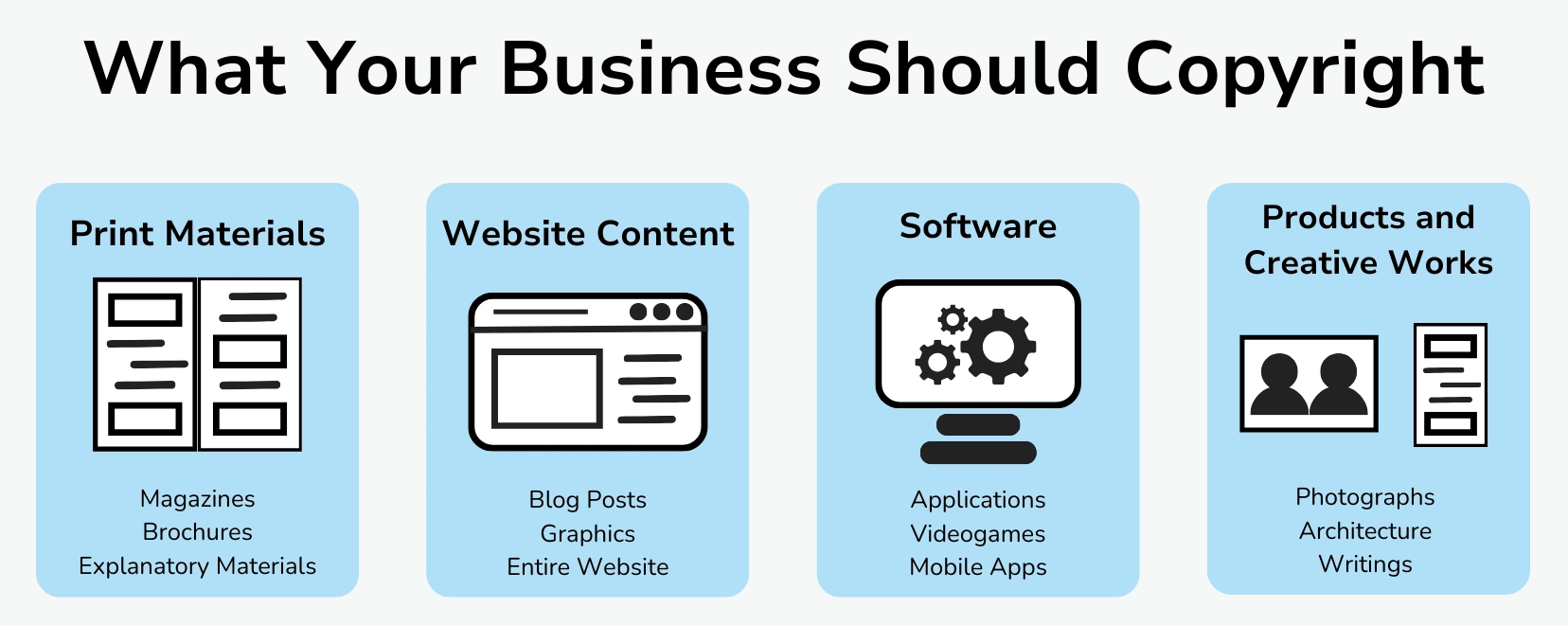
As a new business owner, you have an interest in ensuring that your work remains proprietary and that no competitors rip off the results of your investment in it. But how far should you go in obtaining intellectual property protection over various aspects of your business? Let's look in particular at what elements of your business may be protected through U.S. copyright law.
What Is Copyright?
A "copyright" is a form of intellectual property protection that applies to original works of authorship fixed in a tangible medium of expression. As the definition would suggest, a copyright must be:
- An original work of authorship: A human author must have created the work with a minimal degree of creativity. (In January 2025, the U.S. Copyright Office released a statement saying that AI-produced works could be copyrightable in cases where there's enough human expression.)
- Fixed in a tangible form of expression: The work must be put down in a permanent medium so that the work can be perceived, reproduced, or communicated. You can't copyright an idea, concept, or strategy for your business (contrary to what many executives believe). You can copyright only something that has actually been reduced to written or recorded form.
Common examples of materials that can be the subject of copyright protection include books, brochures, photographs, designs, music, lyrics, plays, speeches, and computer code.
The basics of copyright law come from the Copyright Act of 1976. Though you can find the concept of copyright protection in Article 1 of the U.S. Constitution.
What Rights Does a Copyright Provide?
Unlike other forms of intellectual property, copyright protection happens automatically. As soon as you create a work that meets the copyright criteria (original work of authorship fixed in a tangible medium), you have copyright protections in your work. But these protections are limited. You'll need to register your copyrighted works with the U.S. Copyright Office to take advantage of the full protections under the law (as explained later).
Your copyright grants you exclusive rights. So as the copyright owner, you (or your business) alone have the right to:
- reproduce your copyrighted work (such as linking to your copyrighted work on your business website)
- create derivatives or adaptations of your copyrighted work (for example, releasing new updated versions of your copyrighted computer program)
- distribute copies of your copyrighted work to the public (like licensing your photographs)
- perform your copyrighted work publicly (including literary, musical, dramatic, artistic, and cinematic works), and
- display your copyrighted work publicly (for instance, posting your graphic design portfolio on a marketplace site).
For example, suppose you copyright an essay that you give all your customers about your business philosophy. (Many businesses might put their business thesis on their websites.) Now suppose a competing business takes your essay and tries to use your text for their own benefit, presenting the work at trade shows, distributing it in company pamphlets, and posting it on their website. You could sue the other business for copyright infringement because that business is reproducing your copyrighted work.
Copyright vs. Trademark vs. Patent
Copyright is only one form of intellectual property right. The two other main kinds of intellectual property are trademarks and patents.
Trademark: A "trademark" is a word, phrase, symbol, design, or combination of these elements that identifies a source of goods or services. A trademark is meant to distinguish one provider or source of goods or services from another. Common trademarks include business names, logos, slogans, domain names, and trade dress.
Unlike a copyright, your rights in a trademark only last for as long as you use your trademark. As soon as you stop using your trademark, your rights in that trademark end. With a copyright, your rights last for a specified period of time regardless of your use (as discussed later). However, like a copyright, trademark protection happens automatically. You have protections in a trademark as soon as you start using it. But you can register your trademark for additional protections.
Patent: A "patent" is a legal right to an invention. An invention can be a method, process, machine, device, or composition of matter. Typically, a patent must be useful, novel, and nonobvious. You can apply for a utility patent (based on the invention works) or a design patent (based on how the invention looks). For example, Apple Inc. holds design and utility patents for the iPhone. Despite the telephone having already been invented, the iPhone's smartphone innovations proved to be a novel and nonobvious advancement in telephone technology qualifying for patent protection.
Like a copyright, a patent lasts for a set period of time. A patent lasts for 20 years from the date the patent application is filed. Unlike trademarks and copyrights, patent protection doesn't happen automatically. You must register your patent to receive any protection.
Trade secrets are another, lesser-known form of intellectual property protection. A trade secret can be a formula, process, idea, pattern, device, or compilation of information. To qualify as a trade secret, the secret must have economic value because it's not generally known, you've made reasonable efforts to protect the secrecy of the information, and others could gain value if the trade secret is disclosed to or used by them. Unlike the other kinds of intellectual property, a trade secret's value comes from how the information isn't communicated to the public. Common examples of trade secrets are recipes, customer lists, computer algorithms, and marketing strategies.
Business Elements to Protect
As a starting point, realize that it's likely not worth obtaining federal copyright registration over every single written item your business produces. Rather, you should consider the creative works that are truly important to your business’s operations or identity.
Here are some examples of items upon which you might wish to file copyright registration.
Copyrighting Print Materials
Most obviously, you should consider obtaining federal copyright protection over any print materials central to your business. For example, good candidates for federal registration include:
- brochures
- magazines, and
- explanatory materials aimed at consumers.
Note that if you update these materials substantially (such as once per year), you might wish to obtain a new copyright registration on the updated version to avoid any doubt that could be cast on your rights.
Copyrighting Elements of Your Business Website
Most businesses know that they need good online content to advertise themselves. If your business is investing a lot of money in its content, graphics, and overall design of its website, consider protecting your ownership of the copyright in those materials.
Multiple elements of your website can be copyrighted. For instance, you can copyright individual photographs, artwork, blog posts, and more. You can sometimes copyright a webpage, set of blog posts (or in some cases, the whole website) if it qualifies as a collective work or compilation.
Because individual elements of your website can be copyrighted, you need to make sure you know who owns the copyrights on each element of your website. For example, you might've hired a designer to create graphics and a writer to compose blog posts for your website.
You (or your business) own the copyrights as long as:
- you author the work yourself
- an employee of your business authors the work as part of their job
- you commissioned the work from an independent contractor as a work made for hire, or
- the rights of the copyrighted work were assigned or transferred to you.
If you're contemplating an agreement with an outside firm to create your website or any parts of it, you should include ownership of the copyright as part of your agreement. If you specify in your contract with the firm that your business will own the copyright to the final product(s), you'll be able to use those works for other purposes if you want to.
Assuming you hold the copyright, you should begin using the copyright symbol (©) immediately to inform others that you intend to exercise control over the production, distribution, and display of the work. You can put this copyright notice in the footer of your website so it appears on every page.
Copyrighting Software
If your business has developed software or had software developed for it, you can copyright the software. For example, your business might want to protect software it developed for:
- a mobile app
- customer management or procurement
- communication
- databases
- human resources
- accounting and finance
- project management, and
- marketing.
Perhaps your software is your business product. Alternatively, perhaps your software is for internal use only but is important to giving your business an edge. In either case, you'll want to prevent others from using your software code. The best way to protect your software is to register it and place a copyright notice on your software.
Copyrighting Products and Other Creative Works
Your strategy might be different if your business is in the business of producing creative works. In that case, you might wish to do more thorough copyrighting.
If, for example, you paint paintings, draw custom designs, take photographs, write articles, or design architectural works, it might be worth obtaining a copyright on each of those creations.
Registering your copyright is especially important if you believe you might develop revenue from licensing your work (for instance, through licensing your photography to multiple users). For creative professionals, copyright registration could be an essential piece of your overall business strategy.
How Do You Get a Copyright for Your Business?
As mentioned earlier, you can obtain copyright protection automatically as soon as you fix your creative work in a tangible medium. But if you want the greatest level of protection, and the ability to actually sue infringers in federal court, you should register your creative work with the U.S. Copyright Office, the federal agency charged with administering copyrights.
You can apply for copyright registration online through the Copyright Office's Registration Portal. You'll need to use the application that matches your type of creative work (for example, literary, visual, performing arts, sound recording, or individual work in a serial).
In general, you need three things to register your copyright:
- a completed application
- copies of your work to submit, and
- the nonrefundable filing fee (most fees are below $100).
The registration process is relatively simple and can be completed online. You need to know basic information about the author, the title of the copyrighted work, when the work was created and published, and who is claiming the copyright. If you want your business to own the copyright, you should list the business as the "claimant" on the application.
The Copyright Office provides helpful resources and answers to frequently asked questions to help you with the registration process. But if you need additional help or legal advice, you should contact a business or copyright attorney.
How Long Does Copyright Protection Last?
In general, copyright protection lasts for the life of the author plus 70 years.
For example, suppose you take a photograph that you use in the marketing materials for your business. The copyright for that photograph would last for your lifetime plus 70 years. Your business could still own the copyright. When you register the copyright, you'd list your business as the "claimant." But because you're the original author of the photograph—and copyrights can only apply to works of a human author—the timeline would apply to you personally.
If the work is made for hire or done anonymously, then the copyright lasts the earlier of either:
- 95 years from the year of publication, or
- 120 years from creation.
Suppose you hired a freelancer to write blog posts for your website. In your contract with the freelancer, you specify that the job is work for hire and that your business owns the copyright in any blog posts the writer produces for you. The freelancer writes the blog post and immediately publishes their work on your website. Your business's copyright in their work would last for 95 years from the date the blog posts were published on your site.
Copyright Infringement in Business
It's important to protect your business's intellectual property just like any other assets your company owns. On the other side, it's equally important to take care not to violate others' intellectual property rights.
As covered earlier, copyright grants the owner rights to reproduce, adapt, distribute, perform, and display their copyrighted work. If you violate any of these rights, then you're infringing on the copyright owner's rights. If the copyright owner has registered their copyright, then they can sue you for copyright infringement, which could lead to your business paying a hefty sum in damages, court costs, and attorneys' fees. So you should take care to avoid infringing on other's copyrights.
Protect Your Business's Copyrights
Follow these tips to protect your business's copyrights:
- Register your copyright. When you have a work you want to protect, register it with the Copyright Office. Registering your copyright provides you with many benefits such as the ability to sue infringers. Filing fees are fairly affordable and the process is usually quick and straightforward.
- Use a copyright notice. Regardless of whether you register your copyrighted work, you should use the copyright symbol (©) on any copyrightable work. Using this symbol puts everyone on notice that the work is protected and that you own it. So if they use the work and you sue them for copyright infringement, you can use the notice to prove the infringer had actual notice of your rights. Beside the copyright symbol, make sure you also include the year of publication and the copyright owner's name (probably your business name).
- Enforce your copyright. If you see someone using your copyrighted work without permission, take action as soon as possible. You can send them a cease-and-desist letter asserting your rights in the copyrighted material and demanding that they stop using your work. You could also offer to let them keep using your work in exchange for a licensing fee. If they refuse or ignore your letter and you've registered your copyright, you can sue them for infringement. When you have a case of copyright infringement, it's best to consult an experienced intellectual property attorney early on. A letter from an attorney can prove to be scarier and harder to ignore.
Avoid Copyright Infringement in Your Business
Follow these tips to avoid copyright infringement:
- Only use work in your business that you have permission to use. Perhaps the best solution is to either create your business material and content yourself or hire someone to do it for you. If you hire someone else, make sure you have a written agreement with them. Even better, include a copyright assignment agreement along with your business contract. If you admire someone else's work and want to incorporate it into your business, ask for permission or pay a licensing fee to get the rights to use their work.
- Explore the public domain. The public domain is where works with expired copyrights (or works that can't be copyrighted) live. Works in the free domain are free game to use. There's not one place to look for works in the public domain. But you can search around the internet for public domain content. For instance, if you want to use a photograph in the public domain, search for "public domain photographs."
- Pay attention to permissions and uses. Sometimes a photograph, artwork, or other piece of copyrighted work will say that it's "free for personal use" or "free for personal and commercial use." If you plan to use the work for your business, then your use is commercial. So the works listed as only "free for personal use" are off-limits unless you work out a deal with the copyright owner. But it's best to double-check that you can use the copyrighted work in your business.
- Be careful about using AI. Typically, work produced by artificial intelligence (like ChatGPT or Gemini) isn't copyrightable unless it involves sufficient human expression. On the surface, this limitation is good news: You can use AI-produced content because you wouldn't be infringing on anyone's copyright. After all, no copyright exists. However, copyright owners have filed multiple lawsuits claiming that AI uses their copyrighted works to create the output AI users receive. So, conceivably, when you put a prompt into an AI chatbot (like "write a blog about flower arrangements"), you could be at risk of receiving a response that copies or almost copies someone else's copyrighted work.
Your business can greatly benefit from copyright law. It's important that you take steps to protect your business early on. Copyright only lasts for a certain period so protect it while you have it.
